
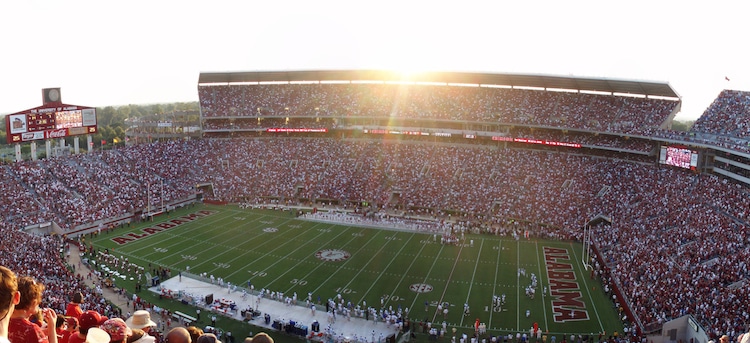

Warning: The article below is a bit of sarcastic humor. I am speaking in hyperbole to make a point. The football fan noted represents a very rabid football fan. The church member represents some, but certainly not all, church members.
Disclosure: I tend to be a rabid college football fan. I see my allegiance as an area of devotion that needs significant adjustments downwardly. So I don’t necessarily practice what I preach. For example, even as I type these words, I am reminded that the kickoff for my team’s first game of the season is exactly five weeks from today.
Caution: While I do write these comparisons with some humor and a lot of hyperbole, you might get just a bit uncomfortable reading them. That may indicate there is some truth in each of them.
- A college football fan loves to win. The typical church member never wins someone to Christ.
- A college football fan gets excited if a game goes into overtime. A church member gets mad if the pastor preaches one minute past the allocated time.
- A college football fan is loyal to his or her team no matter what. A church member stops attending if things are not going well.
- A college football fan is easily recognized by his or her sportswear, bumper stickers, and team flags. Many church members cannot even be recognized as Christians by people with whom they associate.
- A college football fan pays huge dollars for tickets, travel, and refreshments for games. A church member may or may not give to his or her church.
- A college football fan reads about his or her football team every day. A church member rarely reads the Bible once in the course of a week.
- A college football fan attends the game no matter how bad the weather is. A church member stays home if there is a 20 percent chance of rain.
- A college football fan invites others to watch the game every week. A church member rarely invites someone to church.
- A college football fan is known for his or her passion for the football team. A church member is rarely known for his or her passion for the gospel.
- A college football fan will adjust gladly to changes in kickoff time. A church member gets mad if his or her service time is changed by just a few minutes.
- A college football fan is loyal even if he or she never gets to meet the coach. A church member gets mad if the pastor does not visit for every possible occasion.
Yes, I admit I do enjoy college football. But I really love Christ’s churches even more. I need to demonstrate that reality more readily. Do you?
So . . . what would you add to my somewhat sarcastic list? Do you see the humor? Do you see some truth?
Posted on July 26, 2014
With nearly 40 years of ministry experience, Thom Rainer has spent a lifetime committed to the growth and health of local churches across North America.
More from Thom



103 Comments
College football teams have staff coaches, mentors, trainers, and counselors for every position. They understand the priority of developing each player into his full capacity as a player. They stay on top of the player’s training, exercise, memorization of routes, rules and strategies.
The church’s Great Commission, it’s marching orders is much the same. It is to make disciples. Every disciple is a Chistian but not every Christian is a disciple. We need to creat a culture of mentorship where coaches develope young Christians into full disciples.
Well said, Steve.
I understand the sentiment here, as every Christian should be adhering to the great commission, but I think we should be careful distinguishing differences between ‘disciples’ and ‘Christians’, as there is no such distinguishing in the N.T. (c.f. Acts 11:26, etc.). To say that someone can be a Christian, but not be a disciple, and therefore not making other disciples (Christians), is a slippery slope away from the scriptures. There are not different ‘levels’ of Christians (i.e. Christians and disciples) presented in the N.T. other than mature and immature, but both would still be disciples/Christians/believers/people of the way/etc. All descriptive names represented one thing, a follower of Jesus.
A college fan knows the names of all the players and coaches in the team. An average Christian cannot name all 12 disciples of Christ.
In football you have a stadium full of fans. At church you have a building full of players.
You guys are outsmarting me with your comments!
Then get out the gospel of St. Mark and the letter to the Romans and read them out loud in church. They were written for people who did, not people who sat around postulating, like Greeks. When the football coach, be it Bear Bryant or Nic Saban, gives the pep talk, it is not a 30 minute long speech. It is short and to the point.
The guy who wrote Romans preached for six hours one evening. One of his audience fell asleep, fell out of a second story window, and died. Paul went down, raised him from the dead by the power of Christ, and went on to preach for another six hours. How’s that for a pep talk?
I understand the sarcasm, but I’ll present this, rewritten, as ways churchmembers are like football fans. “A college football fan loves to win. A church member loves to win someone to Christ.” I’d rather people get on the bandwagon, feeling left out if they are not doing Kingdom work, than for them to think “nobody else is doing it, so why should I?”
Wow, that was negative. Just like Jesus would’ve said it 🙂
If you made a book cover for your Bible and wrote NFL on it, it could stand for NewFound Life and maybe more people would read it?
Good one!
I think these comments apply to all sports at all levels. Even T-ball.
True.
A college football fan likes it when their team adjusts to changes in their sport. A church member says we’ve never done it that way before!
Ouch. Good.
You left out the end of that sentence. ” and therefore we can’t.”
A college football fan knows that a winning team has a coach who maximizes his available resource potential, whether it be the players, assistant coaches, or even fans. A church member is all too often left wondering why they can’t participate and have their God-given gifts, talents, and abilities recognized or used for the good of the team
Some people are unfortunately of the wrong age, race, gender, marital status, parental status, political persuasion, are pro-choice, drink a little, and/or anything else that is used to determine who is good enough to do x, y, or z. When you carve off everyone who is deemed ineligible, you don’t have many left to do all that needs to be done.
If a college football coach has a bunch of whiny prima dona players who break the team rules or are cancers to their program, they suspend them, pull their scholarships and / or kick them off the team. Churches don’t believe in Biblical Discipline many times today and are, instead, controlled by power hungry people who will run the pastor off the first time they don’t get their way. And Churches are, certainly, not looking to Christ as the head of the Church and seeking to fulfill His purposes for the Church many times these days. They are, however, run by those who simply want to create the Church in their own images and have things their way and fight over their own preferences which are non-biblical. As the commercialize Church has gone, they want to have things their way.
I’m with Paul (above) about what happens when the team struggles. If it referred to NFL (and I’m sure you’d lose readers if you’d made it thus) the coach (pastor), quarterback (Min of Ed), particular players (church members), trainer (SS Teacher), cheerleaders (choir), owner (God Himself) would come under furious attack and threatened with tar & feathers. In the church’s case, nobody EVER thinks the members in the pew (players) aren’t doing their job. Spectator sport, indeed, except the game is life, not football.
Even God started over more than once. The first was the flood which only saved Noah and his family. The second was the time the Hebrew people spent in the wilderness between the Exodus and the entrance into the Promised Land. That was to give time for the people who’d walked out of Egypt to die off. Even Moses was replaced. I’d say that was remaking the team.
Mark,
Are you implying that God tried one plan and when that didn’t work, He went to plan B, C, etc…? If so, that is a very interesting view of God you have there.
You felt that you needed to write a “disclaimer” before making any comments about FOOTBALL, positive or negative. If you had only written about CHURCH, no disclaimer would have necessary.
I do see the correlations that you have written above. There is a fair amount of truth to them. However I’m going to look at it from the other side. So what can the church learn from the way the football team is managed? Periodically football teams have media day where speeches are given on the state of the team or the program and then questions are taken. When was the last time church leaders gave a state of the church address on more than the finances and then were open to questions from anyone? Also when a coach starts losing too often or loses control of the team the fans go to the athletic director and start mentioning to him that it may be time for the coach to go. The AD usually pays attention to these people because they support the program. That does not mean that he immediately dismisses the coach but it may mean that he has a meeting with the coach to discuss these issues and asked the coach what he plans to do. When was the last time that church leaders listened to ordinary people? Also when the entire athletic program is in trouble fans and supporters go to the university administration to get the AD removed. Since the AD is the equivalent of leadership in a church, when was the last time that a congregation got rid of all the church leaders and put in a new group who could run things differently? I have watched too many organizations, both secular and religious, be run into the ground by their leadership, and the people were basically powerless to do anything about it even though we knew the problems and had come up with potential solutions.
Most athletic programs also pay attention to what is being said about them on blogs, message boards, and in the press. Sometimes they are forced to respond publicly to squelch a festering issue. When was the last time church leaders went searching the net to see what was being said about themselves and their congregation/denomination and then issued a response?